Description
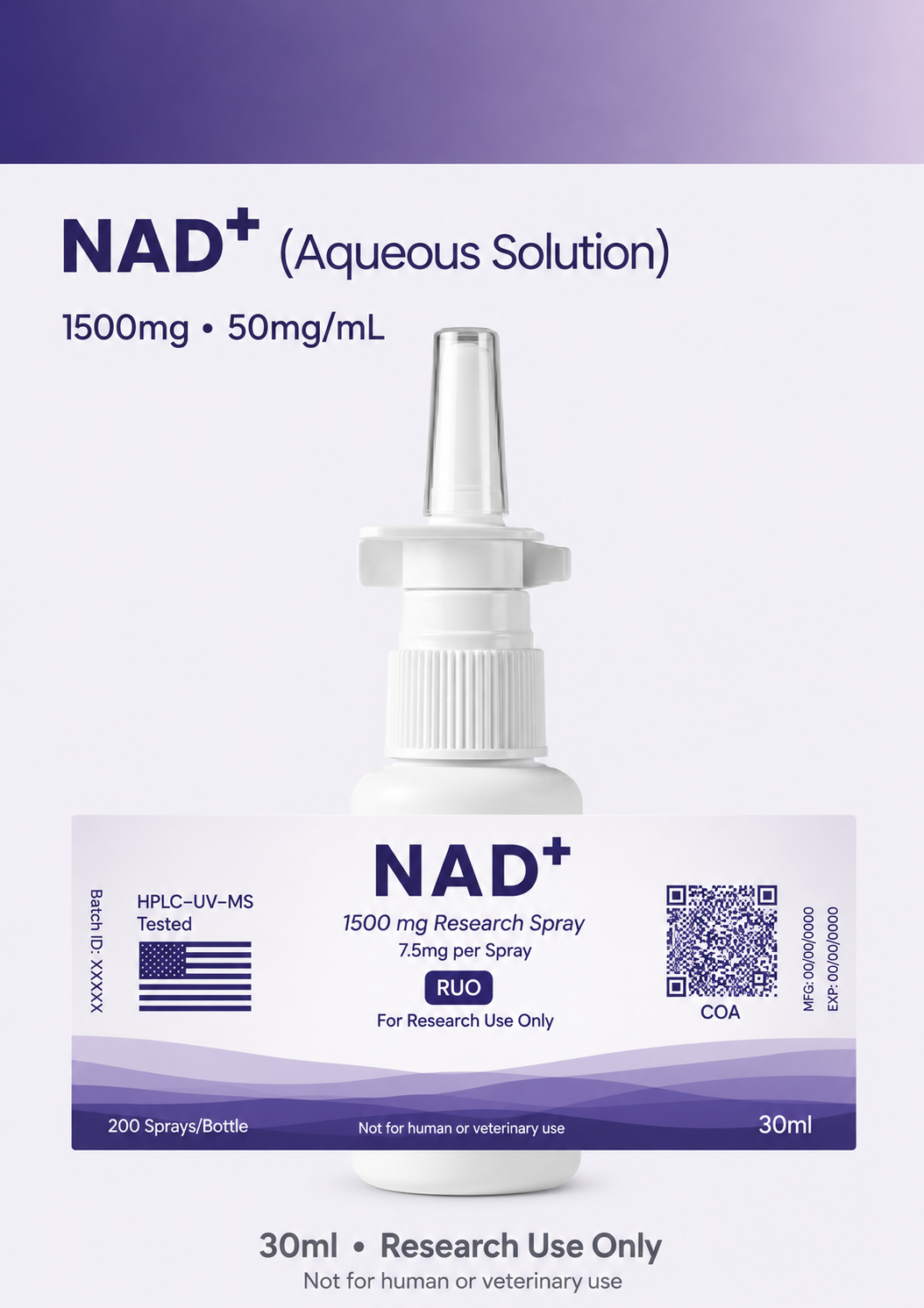
NAD+ Research Compound
NAD+, or nicotinamide adenine dinucleotide, is a naturally occurring coenzyme found across living organisms. It participates in oxidation-reduction reactions and functions as an electron-transfer cofactor in numerous biochemical processes. PubChem describes NAD+ as the oxidized form of nicotinamide adenine dinucleotide and identifies it as a cofactor involved in redox reactions.
Unlike the peptide products in the LV Longevity Peptides catalog, NAD+ is not a peptide. Chemically, it is a dinucleotide composed of two nucleotide units joined through phosphate groups, with one portion containing an adenine base and the other containing nicotinamide.
NAD+ Research Applications
NAD+ can be investigated in controlled laboratory environments for:
- Redox and electron-transfer studies
- Enzyme-cofactor research
- NAD+-dependent biochemical reactions
- Cellular metabolism research
- Mitochondrial-associated biochemical studies
- Analytical method development
- NAD+/NADH comparative research
- Coenzyme stability and degradation studies
- Biochemical pathway modeling
These descriptions refer to laboratory research applications and should not be interpreted as claims of human therapeutic effects.
NAD+ vs NADH
An important technical distinction for the product page is the difference between NAD+ and NADH.
NAD+ is the oxidized form, while NADH is the reduced form. PubChem identifies NADH as 1,4-dihydronicotinamide adenine dinucleotide and lists it separately from NAD+.
This distinction is valuable for SEO because researchers may search for:
- NAD+
- NAD plus
- NADH
- NAD+/NADH
- Nicotinamide adenine dinucleotide
- beta-NAD
- NAD redox research
The LV product page should make clear that NAD+ and NADH are different redox states and should not be presented as interchangeable products.
Technical Specifications
| Specification | NAD+ |
|---|---|
| Product Name | NAD+ |
| Full Name | Nicotinamide Adenine Dinucleotide |
| Product Type | Research compound / coenzyme |
| Chemical Class | Dinucleotide |
| CAS Number | 53-84-9 |
| Molecular Formula | C₂₁H₂₇N₇O₁₄P₂ |
| Molecular Weight | 663.4 g/mol |
| PubChem CID | 10897651* |
| Oxidation State | Oxidized form |
Chemical Information:
- Chemical Name: Nicotinamide Adenine Dinucleotide (oxidized form)
- Molecular Formula: C21H26N6O14P2
- Molecular Weight: 648.4 g/mol
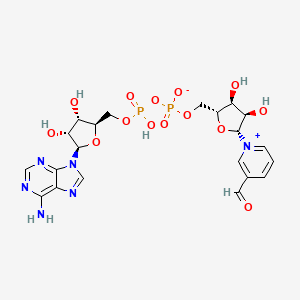
- Structure: Dinucleotide composed of nicotinamide and adenine linked via phosphate groups
Molecular Structure:
FAQ
What is NAD+?
NAD+ stands for nicotinamide adenine dinucleotide. It is a naturally occurring coenzyme involved in oxidation-reduction reactions and electron transfer.
Is NAD+ a peptide?
No. NAD+ is a dinucleotide coenzyme, not a peptide. This distinction should be made clearly on the LV product page.
What is the molecular formula of NAD+?
The commonly referenced NAD+ molecular formula is:
C₂₁H₂₇N₇O₁₄P₂.
What is the molecular weight of NAD+?
The PubChem NAD+ record lists a molecular weight of approximately 663.4 g/mol.
What is the CAS number for NAD+?
The CAS number listed by PubChem for NAD+ is 53-84-9.
What is NAD+ studied for?
NAD+ can be studied in laboratory research involving redox chemistry, electron transfer, enzyme-cofactor systems, metabolic biochemistry, analytical characterization, and NAD+/NADH behavior.
What is the difference between NAD+ and NADH?
NAD+ is the oxidized form of the coenzyme, whereas NADH is its reduced form. PubChem lists NADH separately with the molecular formula C₂₁H₂₉N₇O₁₄P₂.
Is NAD+ the same as nicotinamide?
No. Nicotinamide and NAD+ are chemically different compounds. NAD+ is a larger dinucleotide containing a nicotinamide-containing nucleotide and an adenine-containing nucleotide.