Description
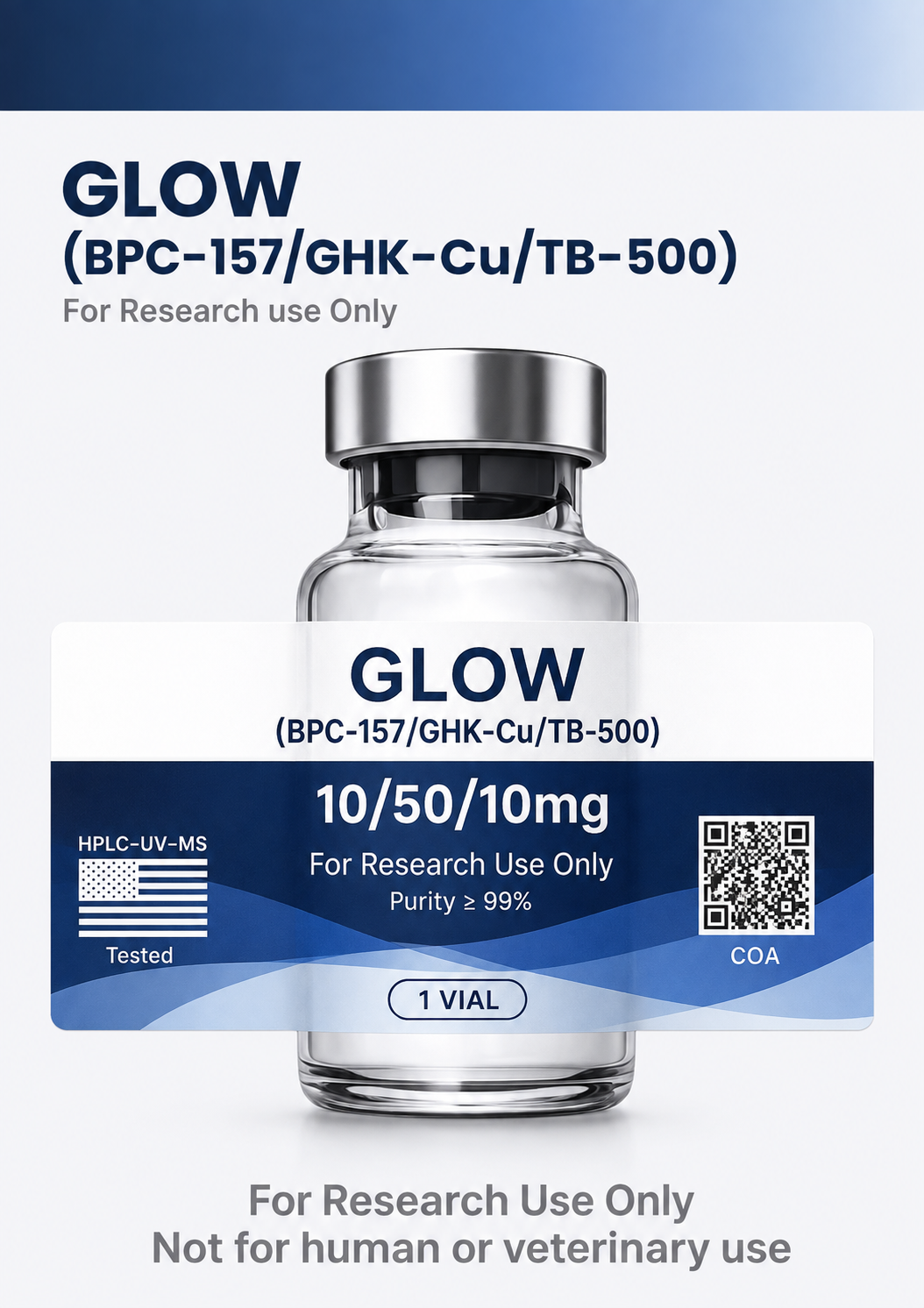
GLOW BPC-157 / GHK-Cu / TB-500 Research Peptide Blend
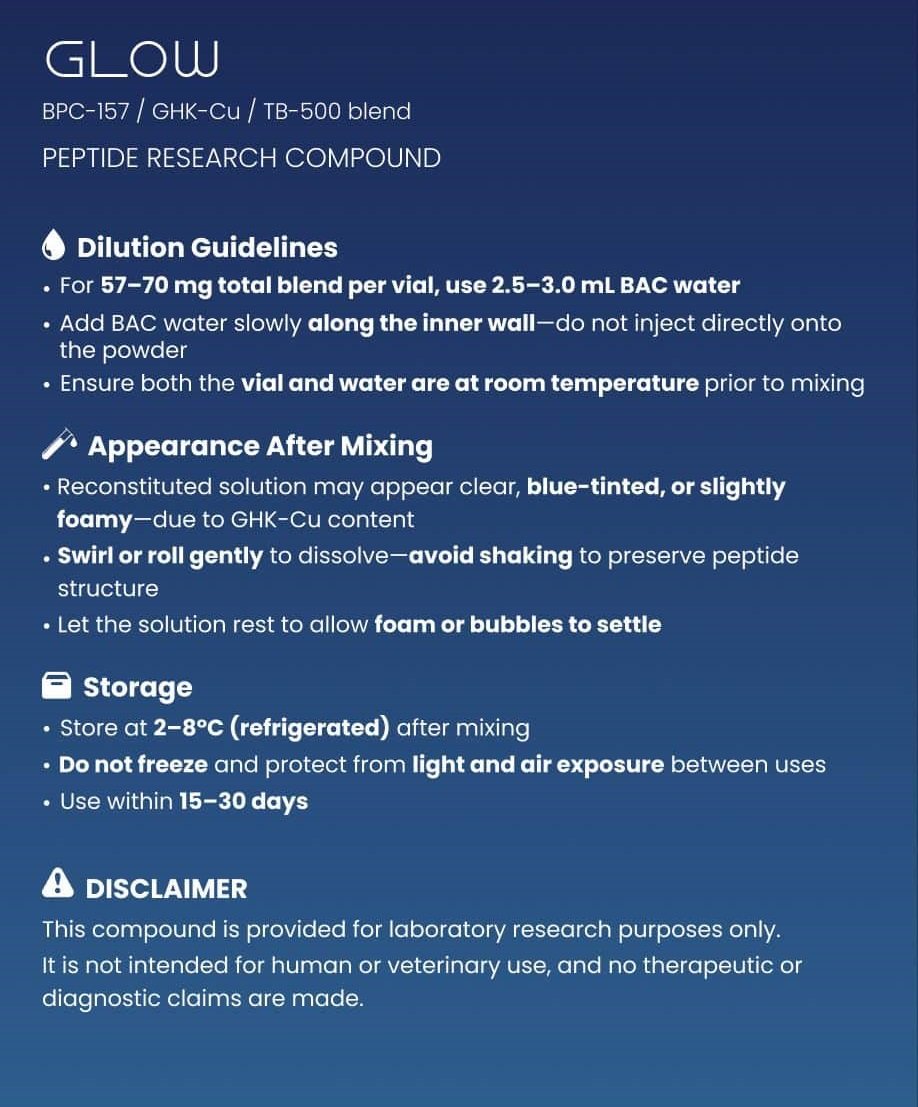
GLOW Peptide Blend is a three-component synthetic peptide research blend consisting of BPC-157, GHK-Cu, and TB-500. The formulation is designed for controlled laboratory research involving the characterization and evaluation of multiple peptide components within a defined research system.
Each component represents a distinct molecular entity with its own structural characteristics, making the blend relevant to researchers investigating peptide composition, analytical behavior, stability, and interactions under controlled in-vitro research conditions.
BPC-157 has a defined 15-amino-acid sequence and a molecular weight of approximately 1,419.5 g/mol. PubChem lists its molecular formula as C62H98N16O22 and its sequence as GEPPPGKPADDAGLV.
GHK-Cu is a copper-associated tripeptide complex consisting of glycyl-L-histidyl-L-lysine associated with copper. PubChem identifies copper tripeptide records with a molecular weight around 400.9 g/mol, illustrating why the analytical form and exact chemical specification should be confirmed using the applicable batch documentation.
The TB-500 designation requires particular attention to chemical identity because nomenclature and sequence descriptions can vary between commercial research materials.
Chemical Information:
- BPC-157:
- Molecular Formula: C62H98N16O22
- Molecular Weight: 1419.54 g/mol
- Sequence: Gly-Glu-Pro-Pro-Pro-Gly-Lys-Pro-Ala-Asp-Asp-Ala-Gly-Leu-Val
- GHK-Cu:
- Molecular Formula: C14H24N6O4Cu
- Molecular Weight: 403.96 g/mol
- *)“GHK-Cu may appear as ~340 Da (peptide only) or ~404 Da (copper complex) depending on MS conditions. The blue color confirms copper is present in the complex.”
- Sequence: Gly-His-Lys-Cu
- TB-500 (Thymosin Beta-4):
- Molecular Formula: C212H350N56O78S
- Molecular Weight: 4963.44 g/mol
- Sequence: Ac-Ser-Asp-Lys-Pro-Asp-Met-Ala-Glu-Ile-Glu-Lys-Phe-Asp-Lys-Ser-Lys-Leu-Lys-Lys-Thr-Glu-Thr-Gln-Glu-Lys-Asn-Pro-Leu-Pro-Ser-Lys-Glu-Thr-Ile-Glu-Gln-Glu-Lys-Gln-Ala-Gly-Glu-Ser
Designed for Laboratory Research
GLOW can be presented as a research material for controlled investigations involving:
- Peptide identity and characterization
- Analytical profiling
- Composition analysis
- Peptide stability studies
- Molecular interaction research
- Comparative peptide investigations
- In-vitro biochemical research
- Multi-component peptide system analysis
The product should not be represented as a medicine, dietary supplement, cosmetic, or therapeutic product.
What Is GLOW?
GLOW Peptide Blend is a multi-peptide research formulation containing BPC-157, GHK-Cu, and TB-500.
Rather than treating the blend as a single chemical entity, researchers can evaluate its individual components and their characteristics within the formulation.
This makes accurate documentation particularly important. The component identities, quantities, chemical forms, analytical results, and batch information should always be taken from the current LV Certificate of Analysis (COA).
Component Overview
BPC-157
BPC-157 is a synthetic 15-amino-acid peptide.
Reference information:
- Molecular formula: C62H98N16O22
- Molecular weight: 1,419.5 g/mol
- Sequence: GEPPPGKPADDAGLV
- CAS: 137525-51-0
These reference characteristics are listed by PubChem.
GHK-Cu
GHK-Cu is a copper-associated peptide complex based on the tripeptide glycyl-L-histidyl-L-lysine.
Reference databases identify copper tripeptide as a distinct copper-peptide complex with a molecular weight around 400.9 g/mol.
For commercial documentation, the exact chemical form and molecular weight should be taken from the LV batch COA.
TB-500
TB-500 is a peptide research material associated with the Thymosin Beta-4/Tβ4 research family.
Because commercial nomenclature can describe different peptide forms under the TB-500 name, LV Longevity Peptides should identify the exact material supplied using its batch-specific COA, analytical identity, sequence and molecular-weight data.
This is particularly important for maintaining accurate product information and avoiding ambiguity between related peptide materials.
Research Applications
GLOW Peptide Blend may be suitable for qualified laboratory researchers conducting controlled investigations involving:
Peptide Characterization
Study the identity and analytical characteristics of BPC-157, GHK-Cu, and TB-500 within a multi-component formulation.
Stability Research
Evaluate peptide stability and degradation characteristics under defined experimental conditions.
Analytical Research
Use appropriate analytical methodologies to characterize peptide components and assess formulation composition.
Molecular Interaction Studies
Investigate interactions between peptide components and defined experimental systems.
In-Vitro Research
Use the material as a research input in controlled laboratory models where the applicable methodology has been validated.
FAQ
What is GLOW peptide blend?
GLOW is a multi-peptide research formulation containing BPC-157, GHK-Cu, and TB-500. It is intended for controlled laboratory research rather than consumer or clinical use.
What peptides are included in GLOW?
The formulation contains three peptide components:
- BPC-157
- GHK-Cu
- TB-500
The exact quantities should be verified against the current LV product specification and batch COA.
What is BPC-157?
BPC-157 is a synthetic 15-amino-acid peptide with the sequence GEPPPGKPADDAGLV and molecular formula C62H98N16O22. PubChem lists its molecular weight at approximately 1,419.5 g/mol.
What is GHK-Cu?
GHK-Cu is a copper-associated tripeptide complex based on glycyl-L-histidyl-L-lysine. Its exact chemical form and analytical characteristics should be confirmed using the relevant product documentation.
What is TB-500?
TB-500 is a peptide research material associated with the Thymosin Beta-4 research family. Because the TB-500 name can be used for different peptide forms, the exact identity should be confirmed using the product’s batch-specific analytical documentation.
What is GLOW used for?
GLOW is intended for controlled laboratory research involving peptide characterization, analytical testing, stability studies, molecular interactions, and other appropriate in-vitro research applications.
Is GLOW for human use?
No. GLOW is for research use only and is not intended for human or veterinary use.
Does GLOW have a standardized composition?
Not necessarily. Commercial formulations marketed as GLOW can use different component quantities and formats. Therefore, the LV product specification and batch-specific COA should be treated as the authoritative source for the exact formulation.
Reviews
There are no reviews yet.